

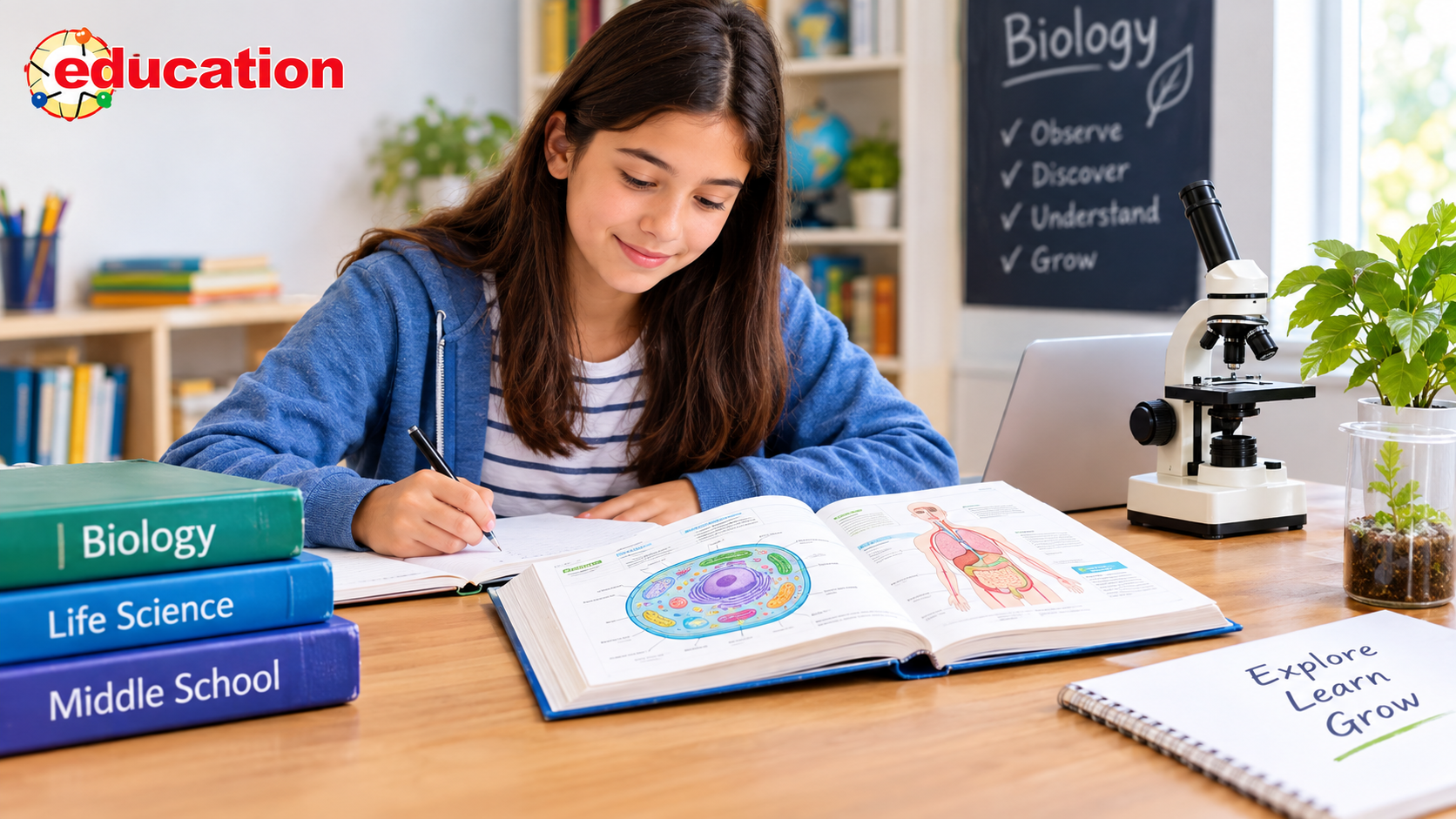
What Should a Good Middle School Biology Curriculum Teach?
A good Middle School Biology Curriculum should do more than ask students to memorize names, terms, and diagrams. Biology becomes far more interesting when students can see how living things work and connect each lesson with something familiar. A student should be able to look at a plant, think about the human body, or notice what happens after exercise and relate it to a science lesson. That is the kind of learning that stays with a student long after a quiz has ended.
Table of Contents
- Start With the Basics
- Make Cell Biology Clear
- Show How Chemistry Supports Biology
- Connect Biology With the Human Body
- Use Pictures to Teach Difficult Ideas
- Give Each Lesson a Clear Purpose
- Help Students Think, Not Just Memorize
- What Homeschool Families Should Look For
- Frequently Asked Questions
- Give Your Student a Better Start With Biology
Start With the Basics
Middle school biology should begin with ideas students can follow. A long list of new words can make a simple subject seem difficult. Students first need to see what biology is about and why the subject matters.
Living things have certain needs. They use energy, grow, repair parts of their bodies, respond to changes, and depend on many smaller parts working together.
Once those ideas are clear, new terms become easier to remember. A student can attach a new word to an idea rather than trying to memorize a definition with no clear purpose.
A strong course should build one idea upon another. Each lesson should prepare students for what comes next instead of making every topic feel separate.
Make Cell Biology Clear
Cells are one of the most important parts of middle school biology, but students should not have to memorize a cell diagram without knowing what the parts actually do.
A cell has many jobs to carry out. It needs energy. It needs materials. It must get rid of waste. It also needs instructions that help the cell grow and carry out its work.
A good lesson should show students how these jobs are handled. For example, students should learn why the cell membrane matters and how mitochondria help provide energy. They should also see how genetic material gives cells important instructions.
The goal is simple. Students should be able to look at a cell and explain how its parts help keep it working.
Show How Chemistry Supports Biology
Biology does not stand alone. Basic chemistry helps students see why many biological processes happen.
Food, water, oxygen, and other materials are made of tiny building blocks. Those building blocks can join, separate, and change. Such changes are important for life.
Students do not need an advanced chemistry course to study middle school biology. They need a clear introduction to ideas that support later lessons.
For example, learning about molecules can make cellular processes easier to follow. A student can see that the body does not simply “make energy” from food. Food goes through a series of changes that allow cells to get usable energy.
A clear explanation can turn a confusing process into something a student can picture.
Connect Biology With the Human Body
Human biology can make science feel personal because students are learning about something they experience every day.
Ask a student why the heart beats faster after running. Ask why breathing becomes harder during exercise. Ask why a cut on the skin can heal. These questions can lead directly to useful biology lessons.
The human body also shows students how different parts work together. The heart, lungs, blood, muscles, brain, and other organs do not work as separate pieces. Each has a job, and those jobs are connected.
A strong middle school course should use such examples to help students see biology as something real rather than a subject that only exists inside a textbook.
Use Pictures to Teach Difficult Ideas
Some biology topics are hard to explain with words alone. A good picture can make a major difference.
Students can look at a diagram and see how parts connect. A graph can show a change over time. A narrated image can guide students through a process one step at a time.
That is why visual teaching plays such an important role at Fascinating Education. I believe students often learn better when they can see an idea while hearing a clear explanation.
The picture should also have a purpose. Adding more images does not automatically improve a lesson. A useful visual should help answer a question, show a process, or make a relationship easier to see.
Give Each Lesson a Clear Purpose
Students learn more easily when they know what they are supposed to take away from a lesson.
A biology lesson should introduce a clear idea, explain it step by step, review the key points, and give students a chance to think about what they have learned.
A short review can help bring the main ideas together. Questions can then ask students to recall information or apply it to a simple situation.
That structure gives students a chance to learn at a steady pace. It also makes it easier to return to an earlier lesson when a topic needs another look.
Biology has many connected ideas, so a clear order matters. A student who has a solid grasp of cells will have a better starting point for later lessons about tissues, organs, body systems, and other topics.
Help Students Think, Not Just Memorize
Memorization has a place within science, but it should not carry the entire course.
A student may remember that mitochondria are linked with energy. A stronger result comes when the student can also explain why cells need energy and what could happen if a cell could not get enough.
Good biology questions should go a little deeper.
- What does this part do?
- Why does the body need it?
- What happens when it does not work properly?
- How does one part depend on another?
Questions like these encourage students to connect ideas. They also help students remember lessons for a reason rather than simply recalling words for a test.
That approach sits at the heart of my teaching style. I want students to see how science works, not simply collect facts about it.
What Home-school Families Should Look For
A home-school biology course needs to do more than provide a list of chapters. Parents should look for lessons that give students clear explanations and enough support to work through a topic at a comfortable pace.
A useful home-school Biology Curriculum Middle School should have a logical order, clear visuals, spoken explanations, reviews, and questions that help students stay active during lessons.
Parents should also look at how difficult topics are explained. A course may cover many subjects, but a large topic list does not always mean better teaching.
If you are looking for the Best Middle School Biology home-school Program, ask a simple question: can your child explain what was taught after the lesson?
If the answer is yes, the course is doing more than giving information. It is helping the student learn.
Frequently Asked Questions
1. What should a middle school student know about cells?
A student should know that cells are the basic working units of living things. They should also know the main cell parts and what those parts do. More importantly, students should see how the parts work together.
2. Why should biology lessons include chemistry?
Many life processes depend on materials and chemical changes. Basic chemistry gives students a simple way to see why those changes happen. It can also make later biology topics easier to follow.
3. How can parents tell if a biology lesson is working?
Ask your child to explain the lesson without looking at the material. Ask them to describe what happens, why it happens, and how the idea connects with something else they have learned. A clear explanation is a much better sign of learning than memorizing a list of terms.
4. Should middle school biology include human body lessons?
Yes. Human biology gives students familiar examples that can make science easier to connect with daily life. Topics such as breathing, digestion, movement, circulation, and healing can also show how several body systems work together.
5. What makes a biology course easier for a home school student to follow?
Clear explanations, useful visuals, a sensible lesson order, regular reviews, and questions can make a major difference. Students also benefit from lessons that explain difficult ideas without filling every page with complicated language.
Give Your Student a Better Start With Biology
You do not need to make biology harder than it needs to be. Your student needs clear lessons, useful pictures, steady explanations, and chances to think about what they have learned. At Fascinating Education, you can give your student a learning approach built around those ideas. You can use narrated visuals, step by step lessons, reviews, summaries, and questions to help science become easier to follow. If you are looking for a Middle School Biology Curriculum that puts real learning ahead of simple memorization, Fascinating Education gives you a practical place to start.